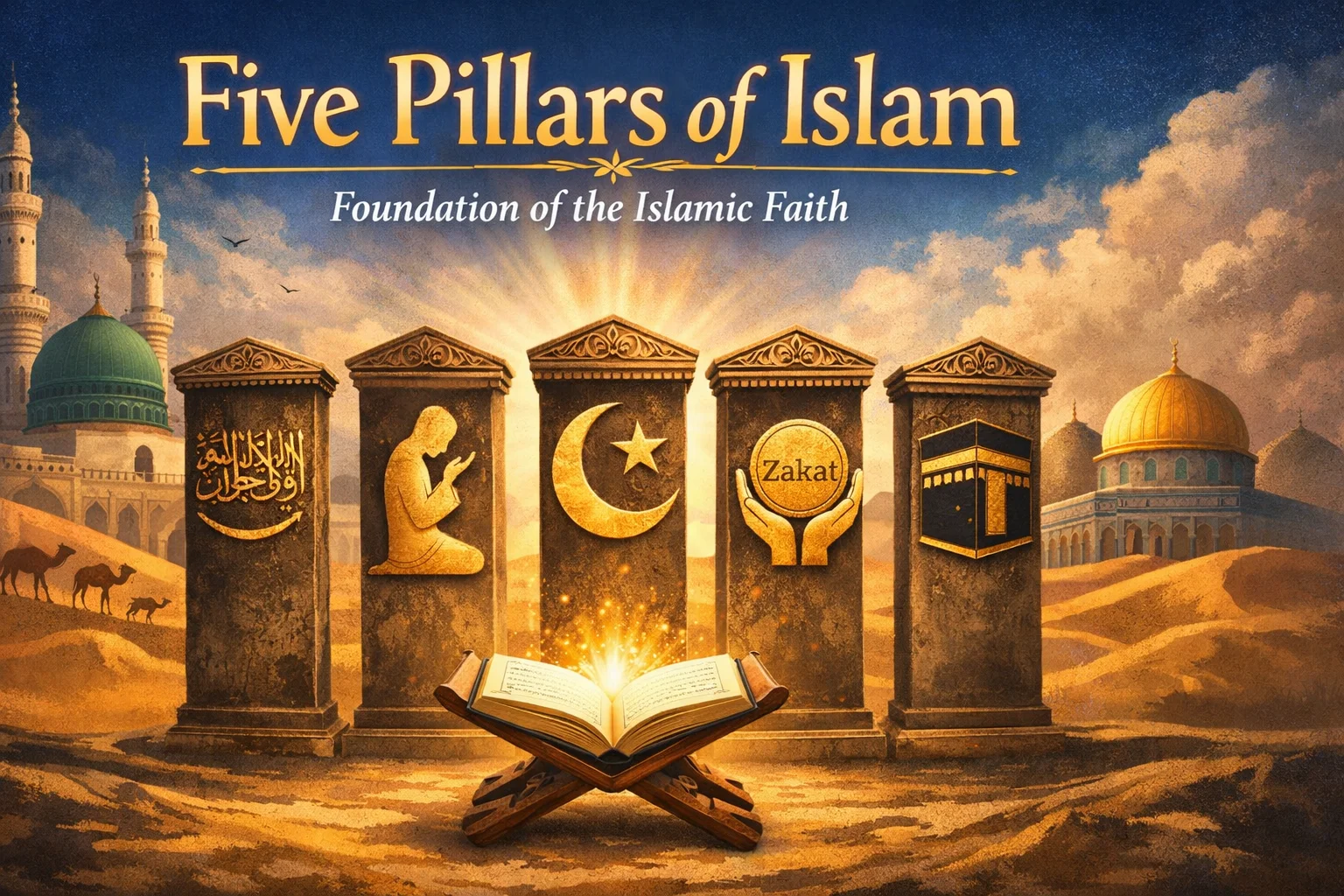

Islam is the original religion of Adam and Abraham, based on the Quran, which Muslims consider the verbatim word of Allah, and the teachings of the Prophet Muhammad (PBUH). Faith in Islam is defined as a firm belief in Allah, His angels, His books, His messengers, the Day of Judgment, and destiny, both good and bad. Faith is the primary foundation that every Muslim must possess. Without faith, one’s actions would lack clear direction and purpose. Faith provides strength and motivation for a Muslim to live according to Allah’s teachings. Allah says:
إِن يَنصُرْكُمُ اللَّهُ فَلَا غَالِبَ لَكُمْ وَإِن يَخْذُلْكُمْ فَمَن ذَا الَّذِي يَنصُرُكُم مِّن بَعْدِهِ وَعَلَى اللَّهِ فَلْيَتَوَكَّلِ الْمُؤْمِنُونَ
“If Allah helps you, none can overcome you: If He forsakes you, who is there, after that, that can help you? In Allah, then, let believers put their trust.” (Surah Al Imran 3:160)
Faith is the most important foundation for a Muslim to have. We live in this world under Allah’s permission, so that everything we do must please Him. Islam is a continuation of the same message preached by all of Allah’s prophets, ending with the final prophet, Muhammad (PBUH), calling people to believe and worship in the one, true Allah alone. In the Islamic worldview, this knowledge is coded into our subconscious makeup. Faith would define our fate in the Hereafter to the Day of Judgement, so we need to have strong faith. Allah says:
إِنَّ الَّذِينَ آمَنُوا وَعَمِلُوا الصَّالِحَاتِ لَهُمْ جَنَّاتٌ تَجْرِي مِن تَحْتِهَا الْأَنْهَارُ ۚ ذَٰلِكَ الْفَوْزُ الْكَبِيرُ
“Verily, those who had faith and had done righteous deeds will have gardens beneath which rivers flow. That is a great achievement.” (Surah Al-Buruj 85:11)
Faith is the belief that underpins all actions, knowledge illuminates the path of life, and deeds are the tangible actions that reflect one’s faith and knowledge. By understanding and practising, a Muslim can achieve a more meaningful and fulfilling life. Faith clarifies the purpose of creation and guides us on how to live a Godly, righteous life. The Quran, God’s final words revealed to Prophet Muhammad, and prophetic teachings (Sunnah) offer guidance on how to adhere to the message.
Here are some effective ways that we can brighten up our Faith starting from today:
- Faith allows a person to truly experience God’s love
- Faith teaches us to live in an Islamic way of life
- Faith leads a believer to trust and hope in God
- Faith teaches that ultimately we will be judged
- Faith rules being Muslim is important in life
- Faith, forgive those who do you wrong
- Faith is to develop a peaceful society
- Faith is the source of all peace
- Faith makes our lives better
- Faith is the true way of life
- Faith in the future of the world
- Faith considers the rights of others
- Faith is having complete trust in God
- Faith leads a believer to sincerely seek
- Faith, repent frequently for your mistakes
- Faith has a message that applies to all people
- Faith is giving charity needy and helping others
- Faith encourages a balance of hope in God’s mercy
- Faith is following the Sunnah of the Prophet Muhammad
يَرْفَعِ اللَّهُ الَّذِينَ آمَنُوا مِنْكُمْ وَالَّذِينَ أُوتُوا الْعِلْمَ دَرَجَاتٍ
“Allah will raise those who have believed among you and those who were given knowledge, by degrees” (Al-Mujadilah: 11)
Gauge and ask yourself how much knowledge you have of the foundational precepts of Islam, and if you have acquired sufficient knowledge to safeguard your Faith. For the sake of your Faith and the Faith of your children, be critical when hearing un-Islamic ideas from people in the community. Reading the Quran will ensure that you connect to the Creator. Belief in Allah or a weakness in your Faith / Iman has to do with understanding who Allah is, and who you are.
Core Beliefs of Faith (Aqidah): These are the six foundations of Faith in Islam:
- Belief in Allah (Tawhid): Allah is One, Supreme, Creator, and has no partners or offspring. Belief in Allah is the foundation upon which a Muslim’s faith is built.
2. Belief in Angels (Malaikah): Unseen, obedient beings created by Allah to carry out His commands.
3. Belief in Holy Books (Kutub): Revelations from God, including the Torah (Moses), the Zaboor (Psalms) that was sent with the Prophet Dawud (David), the Injeel (Gospel) that was sent with Prophet Isa (Jesus) and the Quran which was sent with the Prophet Muhammad(PBUH).
4. Belief in Prophets (Risalah): Messengers sent to guide humanity, including Noah, Abraham, Moses, and Jesus, with Muhammad as the final prophet.
5. Belief in the Day of Judgment (Akhirah): The belief that the world will end, and all humans will be resurrected to face judgment for their actions.
6. Belief in Divine Decree (Qadar): Everything that occurs is a result of Allah’s will and command.
Muslims believe in one God, Allah, who revealed his word to humanity through a line of special messengers known as prophets. Allah’s final prophet was Muhammad, to whom the Quran was revealed. Faith, knowledge, and deeds are complementary elements in a Muslim’s life. By integrating these elements, a Muslim can live a more meaningful and fulfilling life, always staying on the path that pleases Allah. A Muslim with a weak Faith is an easy target for the evil whisper of Shaytaan.
Core Practices (Five Pillars of Islam) that support a Muslim’s life:
- Shahada (Profession of Faith): The declaration that “There is no god but God, and Muhammad is the messenger of God”.
- Salah (Prayer): Five daily ritual prayers performed facing Mecca.
- Zakat (Almsgiving): The obligatory donation of a portion of one’s wealth to those in need.
- Sawm (Fasting): Fasting from dawn to sunset during the holy month of Ramadan.
- Hajj (Pilgrimage): The pilgrimage to Mecca is required at least once in a lifetime if physically and financially able.
Faith must be owned by humans to carry out the command of Allah as much as possible. Knowledge in Islam is highly valued and considered a means to draw closer to Allah. Knowledge encompasses not only worldly matters but also religious and spiritual understanding. In Islam, seeking knowledge is an obligation for every Muslim, both men and women.
Allah Almighty says in The Holy Quran:
- “Do not despair of the mercy of Allah.” (Az-Zumar, 53)
- “Allah wishes to accept your repentance…” (Quran 4:27)
- “Call upon your Lord humbly and in secret.” (Quran 7:55)
- “There must be no coercion in matters of faith!” (Quran 2: 256)
- “Remembrance of Allah indeed is the greatest virtue.” ( Quran 29:46)
- “My Lord, indeed I have wronged myself, so forgive me.” (Quran, 28:16)
- “And whoever does not repent, they are the wrongdoers.” (Quran 49:11)
- “Obey Allah and the Messenger that you may obtain mercy.” (Quran 3:132)
- “Surely Allah is Most Gentle, Ever Compassionate to people.” (Quran 22:65)
Faith always leads a man to a life of obedience and submission to the Will of Allah. The relationship between knowledge and faith is very close, as knowledge helps strengthen faith and provides clear guidance for living. Studying the Quran and Hadith, attending religious classes, and applying the learned knowledge in everyday actions. The best Muslims are those who inspire people to practice Islam and attract people towards Islam with their good character and manners.
How to make my Faith in Islam stronger:
- Remembrance of Allah daily as much as possible: “Remember Allah abundantly, so that you become successful” (Quran 8:45)
- Following the Sunnah of the Prophet Muhammad (SAW):
- Recite the Quran and Its Meaning: The Quran is the best remedy for our souls and minds. It contains the guide for living in the world
- Repent frequently for your mistakes: “Seek forgiveness of your Lord and then turn to Him in repentance.” (Surah Hud: 3)
- Perform Salah (Prayer) regularly: The only way to be regular with your prayers is to remember Allah throughout the day
- Voluntary Fasting: Fasting helps us be thankful to Allah for His Bounty and control unlawful desires
- Carrying out good deeds: Our good deeds are our eternal investment, which will benefit us for the rest of eternity
- Regular with your prayers: The only way to be regular with your prayers is to remember Allah throughout the day
- Giving Charity to the needy: Charity is one of the main ways of increasing in faith
- Gaining more religious knowledge: Learn more about Islam to fall in love with Allah even more
- Surround Yourself with Good People: Choosing the right friends in because they influence your faith in Allah
- Remember that everyone has problems: Sounds like common sense, but it’s not common practice amongst us.
- Making as much as Dua (Supplication): We can and should make Dua in every condition
إِنَّمَا الْمُؤْمِنُونَ الَّذِينَ إِذَا ذُكِرَ اللَّهُ وَجِلَتْ قُلُوبُهُمْ وَإِذَا تُلِيَتْ عَلَيْهِمْ آيَاتُهُ زَادَتْهُمْ إِيمَانًا وَعَلَىٰ رَبِّهِمْ يَتَوَكَّلُونَ
“They only are the (true) believers whose hearts feel fear when Allah is mentioned, and when His revelations are recited unto them they increase their faith, and who trust in their Lord.” (Surah Al-Anfal 8:2)
Creating and nurturing a connection with Allah is the fastest and most beneficial way to increase Faith. This is the foundational requirement for strengthening the Faith in Allah. Every muslim suffers from dips in their Faith. We all go through the highs and lows of life, and our Faith can often be severely affected by it. Islam guides Muslims in belief, worship, behaviour, and responsibility toward others. May Allah enable us to acquire knowledge of the strong Faith and practices of Islam in the best manner.

